Base → Elections → Introduction and statistics
185 years of voting in Canada
by Maurice Y. Michaud (he/him)
 Although Canadians are often accused of being smug when comparing themselves with their neighbours to the south, it is indisputable upon examining the current state of politics in the United States that the blush is off the rose that presents itself as “The Beacon of Democracy.” Even though we, too, are witnessing a sharper polarization within the electorate, at least we do not have to contend with systemic flaws that would make us vulnerable to shenanigans like overt gerrymandering, as is the case over there. As such, each time we are called to the polls, we should be celebrating and giving thanks to the fact that we have something that many people around the world would literally die to have!
The table below shows, by jurisdiction, the year of the earliest and latest recorded event as well as the number of the earliest and current assembly (or of the last one in the case of the former North-West Territory or the Province of Canada).
- Keep in mind that, for each general election (Elec), there is an individual race in each riding, while more than one race could occur during any given by-election.
- What’s more, note that this table makes a distinction between the absolute number of races (N) and the number of real races (n) by subtracting from the former the number of races won by acclamation (Accl.).
- The structure is in place to eventually enter the results of the elections in the Province of Canada (1841–1867). Most of the data is missing for now, and it is quite possible that it will never be uncovered. However, the purpose of having the Province of Canada in PoliCan is to provide an easy-to-consult archive of all those men who ran for and were elected to that legislative body, and to illustrate how the politicians at the time of Confederation did not come out of thin air. Similarly, it allows to identify which politicians continued their career (or were allowed to continue it) after the Rebellions of 1837–1838 in Upper and Lower Canada.
- If we include the races in the Province of Canada, there are currently 860 for which data are missing, out of 41,093 races. That gives a completion rate of 97.91%. However, if we ignore the 1,037 races in the the Province of Canada, thus reducing the number of races to 40,056, those with missing data falls to only 58, with the lion’s share of those—42—being from Prince Edward Island. So, from that more reasonable metric given the unlikelihood of ever getting the Province of Canada data, the completion rate jumps to 99.86%.
- Ministerial by-elections (Minis.) are a subset (17.99% of all by-elections). In the Westminster parliamentary system as practised in most jurisdictions in Canada up until the 1930s, a person who was named to the cabinet for the first time was required to resign their seat and run in such an election soon afterwards. Many of those were won by acclamation, and extremely rare were the times when a newly minted minister would fail to regain their seat even if it was challenged... except in pre-Confederation Newfoundland where it was a real gamble.
- Referendums can never be won by acclamation as they are by definition questions (Q) offering a choice between at least two options.
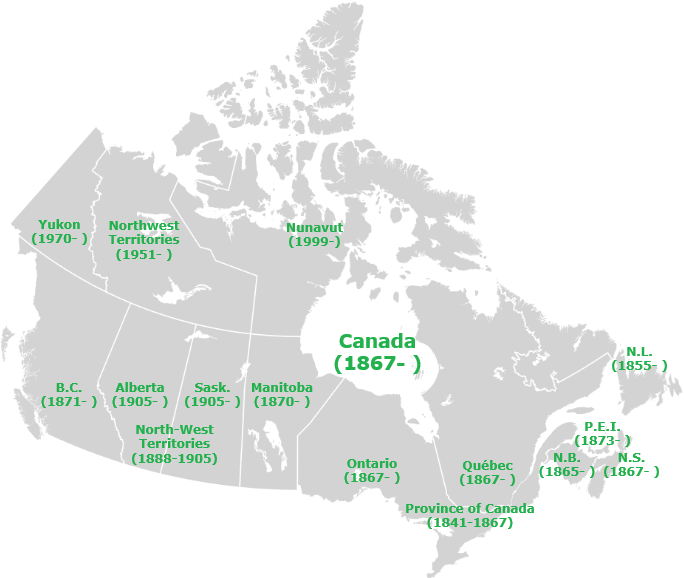
In short, the PoliCan database contains more than 3,000 “elections” since 1841, and more than 41,000 individual “races” within them. Although Confederation only began in 1867, New Brunswick’s 1865 general election is widely viewed today as its first of the Confederation era, as the government elected that year was explicitly anti-Confederation. However, in April 1866, in its reply to the throne speech, the Legislative Council — the colony’s equivalent of the Senate — overrode this position, triggering the resignation of the government and another general election the following month. For their part, the three other new provinces each held a general election in 1867. Similarly, the 1873 general election on Prince Edward Island was held a few months before the province formally joined Confederation. And while Newfoundland only joined Confederation in 1949, it seriously considered doing so in the 1860s and after each of its several economic downturns up to the formation of the Commission of Government in 1934, so its elections from its first responsible government in 1855 are also included.
You can begin exploring the detailed election results right now!
Clicking on the name of any jurisdiction on this map will open a popup window taking you to them.
As for the missing data...
- There is little hope of ever finding the missing data for by-elections in Prince Edward Island. The reason is that, in the smallest provincial jurisdiction, Elections PEI has the most incomplete and chaotic record keeping practices. They produce beautiful statistical reports that consistently fail to give (or make hard to find) data points that really matter, like the number of eligible voters and the number of rejected votes, so unless they’re hiding this data in some secret vault (which is doubtful)... What’s more, for more than 200 years, ridings were merely numbered slices of the three provincial counties, with each county having five two-member ridings (e.g., Kings / Prince / Queens 1st, 2nd, 3rd...), with Queens getting a sixth two-member riding for Charlottetown starting in 1966.
Despite switching to 27 named single-member districts in 1996, Elections PEI seems to remain stuck in thinking in numbered district terms: “See the results of the by-election in District 16” instead of “See the results of the
by-election in Cornwall—Meadowbank.” And for the general elections from 1966 to 1993, the sum of enumerated voters in each district is greater than the province’s population at the time! So let’s just say that it is a struggle to find, interpret and enter the electoral results of a province that has a smaller population than the
City of Sherbrooke or 29 other Canadian
cities!
- On the other hand, the largest provincial jurisdiction, Ontario, has one of the most complete datasets online provided by Elections Ontario, but the details for by-elections prior to 1987 were extremely hard to find. With the naive hope that giving a little might yield a little, PoliCan respectfully submitted to Elections Ontario in March 2021 a listing of 180 errors found in their “Data Explorer” application, hoping that, in exchange, they would consider adding to it the missing by-election results. Not only did they decline to entertain the idea; 166 of the 180 errors flagged remained in their application as of late December 2022. So, by the summer of 2026, thanks to a lot of grit and determination, the number of Ontario races with missing data was reduced to only 5 in PoliCan.
- The decentralized record-keeping practices for elections in the 19th until the early 20th century, combined with political instability exacerbated by the sectarianism of that period, make it unlikely that the results from the Province of Canada and pre-Confederation Newfoundland can be made more complete than they are now in PoliCan.
Nevertheless, nowhere other than PoliCan will you find 99.86% of the verified electoral results in Canada since 1867, in a standardized and easily searchable format, and with so many links expanding on the people who ran for office.
© 2005, 2026 :: PoliCan.ca (
Maurice Y. Michaud)
Pub.: 23 Dec 2021 10:07
ET
Rev.: 8 Aug 2026 00:19
ET (data presented dynamically)